


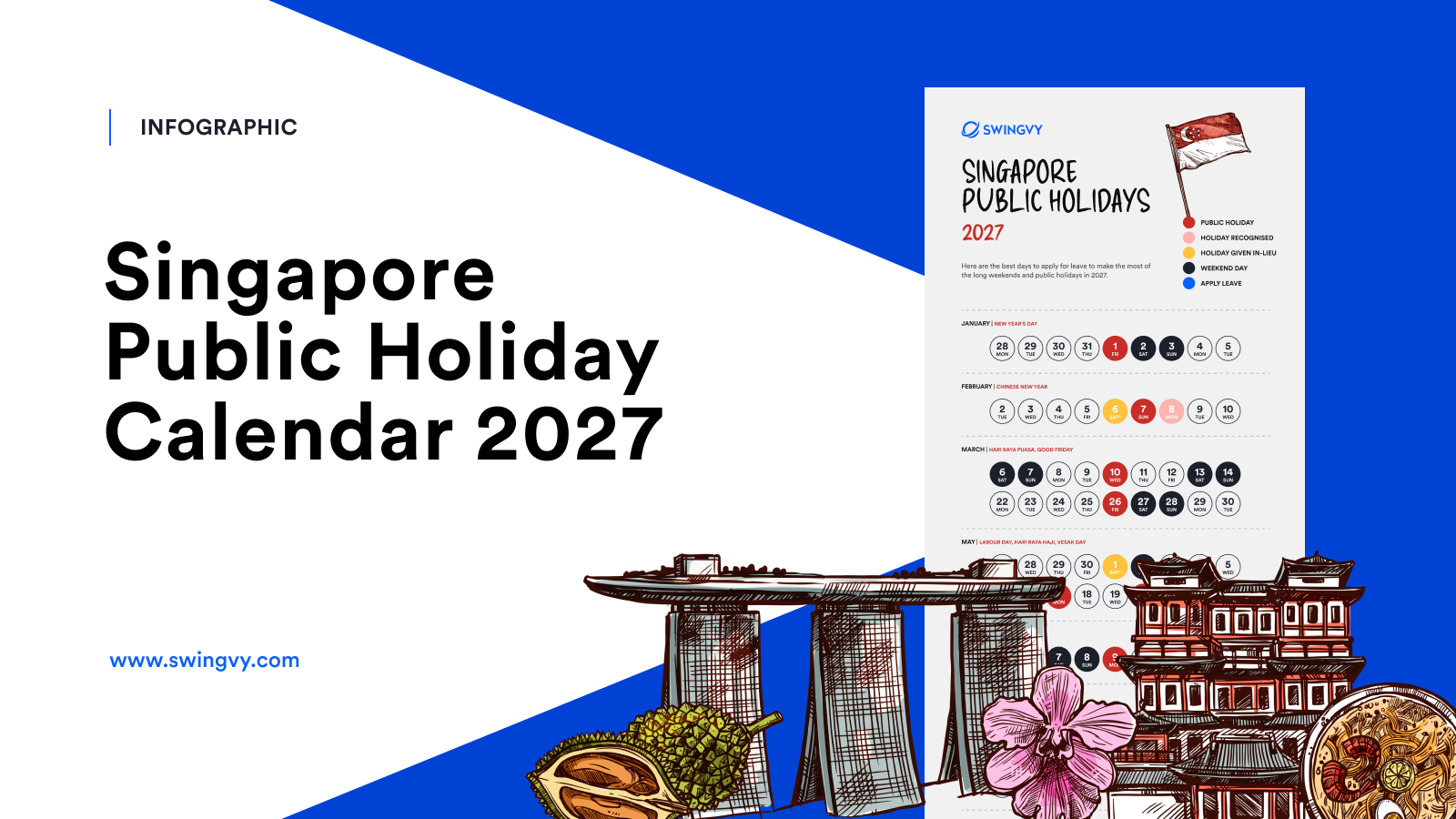
As we approach 2027, both HR professionals and employees need to stay ahead of the public holiday calendar. Whether you're planning workforce schedules or mapping out your annual leave, understanding Singapore's public holidays is essential for smooth operations and maximizing your time off!
For Employees: Looking to plan your vacation days strategically? This guide will show you how to make the most of your public holiday entitlements, understand your rights when working on holidays, and spot those perfect long weekend opportunities throughout 2027.
Let's dive into everything you need to know about Singapore's public holiday 2027!
What MOM Says: Public Holiday 2027 Official Dates
The Ministry of Manpower (MOM) announced the 11 gazetted public holidays for 2027 on 18 June 2026, and there are five long weekends to look forward to: New Year's Day, Chinese New Year, Good Friday, Hari Raya Haji and National Day. Here's the complete public holiday calendar:
Public Holiday in January to March: New Year's Day, Chinese New Year, Hari Raya Puasa, Good Friday
- January 1 (Friday): New Year's Day
- February 6-7 (Saturday - Sunday): Chinese New Year
- February 8 (Monday): Chinese New Year Holiday (in lieu of Sunday)
- March 10 (Wednesday): Hari Raya Puasa
- March 26 (Friday): Good Friday

Public Holiday in May: Labour Day, Hari Raya Haji, Vesak Day
- May 1 (Saturday): Labour Day
- May 17 (Monday): Hari Raya Haji
- May 20 (Thursday): Vesak Day

Public Holiday in August to December: National Day, Deepavali, Christmas Day
- August 9 (Monday): National Day
- October 28 (Thursday): Deepavali
- December 25 (Saturday): Christmas Day

Plan Your Long Weekends and Bridge Days in 2027
Five public holidays give you a three-day weekend in 2027, so it's worth locking in your travel plans early:
- New Year's Day: Friday 1 January to Sunday 3 January
- Chinese New Year: Saturday 6 February to Monday 8 February
- Good Friday: Friday 26 March to Sunday 28 March
- Hari Raya Haji: Saturday 15 May to Monday 17 May
- National Day: Saturday 7 August to Monday 9 August
Two more holidays are easy to stretch. Vesak Day (Thursday 20 May) and Deepavali (Thursday 28 October) both fall on a Thursday, so one day of leave on the Friday after each gives you a four-day break. In the calendars above, these leave days are marked in blue.
In May you can go further: apply for leave on Tuesday 18, Wednesday 19 and Friday 21 May, and Hari Raya Haji and Vesak Day become nine days off in a row, from Saturday 15 May to Sunday 23 May.
Labour Day (Saturday 1 May) and Christmas Day (Saturday 25 December) fall on a Saturday, so they do not create an extra long weekend.
When a Public Holiday Falls on a Saturday or Sunday in 2027
Four of the 11 public holidays land on a weekend in 2027: Chinese New Year on Saturday 6 February and Sunday 7 February, Labour Day on Saturday 1 May and Christmas Day on Saturday 25 December. This is how MOM says to handle them:
- Sunday holidays: MOM has confirmed that Monday 8 February 2027 will be a public holiday, because the second day of Chinese New Year falls on a Sunday. If an employee's rest day falls on 7 February, the next working day is a paid holiday.
- Saturday holidays: If an employee does not work on Saturdays (for example, on a five-day work week), the employer can either pay one extra day's salary or give another day off in lieu of that public holiday. In 2027 this applies to Chinese New Year, Labour Day and Christmas Day.
- Working on the holiday: Employees who are required to work on a public holiday are paid an extra day's salary at the basic rate of pay, on top of their gross rate of pay for that day. See the pay rules below.
Tip for employers: decide early whether you will pay or give a replacement day off for the three Saturday holidays, and tell your team before the year starts, so that payroll and leave records are ready.
Public Holiday Pay: What Every Singapore Employer Should Know
Understanding public holiday pay is crucial for HR professionals and employers in Singapore. Let's break down the key points according to the Employment Act:
Basic Entitlement
All employees covered by the Employment Act are entitled to 11 paid public holidays per year. It's important to note that:
- Employers and employees can mutually agree to substitute a public holiday for another working day. (Read more: A Comprehensive Guide to Calculate Overtime Pay in Singapore)
- This ensures flexibility while maintaining employee benefits.
Compensation for Working on Public Holidays
When employees are required to work on a public holiday, they are entitled to:
- An extra day's salary at the basic rate of pay
- PLUS their gross rate of pay for that day
Time-Off-In-Lieu Option
Employers have the flexibility to grant time-off-in-lieu instead of extra pay for certain employee categories. This applies to:
- Workmen earning more than $4,500 a month
- Non-workmen earning more than $2,600 a month
- All Managers and Executives
Important Note: The number of hours for time-off-in-lieu must be mutually agreed upon between employer and employee. (Read more: Comprehensive Guide to Time Off in Lieu for Employers and HR in Singapore)
Best Practices for Employers
Here are some tips for HR professionals and employers to prepare for upcoming public holidays:
- Clear Communication: Document and communicate your public holiday policy clearly
- Fair Implementation: Ensure consistent application across eligible employee groups
- Proper Documentation: Keep records of any mutual agreements for holiday substitution
- System Updates: Regularly update your HR systems to reflect current salary thresholds (Read more: Top 5 HR Software for Small & Medium Businesses in Singapore)
Common Questions About Public Holiday Pay
Q1: How is the extra day's salary calculated?
A: The extra day's salary is calculated at the basic rate of pay, not including allowances or other additional payments.
Q2: Can an employer force an employee to work on a public holiday?
A: While employers can request employees to work on public holidays, proper compensation must be provided as per the Employment Act.
Q3: Do part-time employees get public holiday pay?
A: Yes, part-time employees are entitled to pro-rated public holiday pay based on their working hours. (Read more: Understanding Part-Time Employment Regulations in Singapore)
Make Public Holiday Management Effortless with Swingvy
Managing public holidays doesn't have to be complicated. With Swingvy's comprehensive HR software, you can:
✅ Automatically track Singapore's public holiday calendar with real-time MOM updates
✅ Calculate public holiday pay accurately for all employee types – full-time, part-time, and contractors
✅ Manage time-off-in-lieu with complete transparency and audit trails
✅ Generate compliance reports to ensure you're meeting Employment Act requirements
✅ Plan workforce schedules around public holidays with visual calendar tools
✅ Streamline payroll processing with built-in public holiday calculations
Stop juggling spreadsheets and start managing your team with confidence. Try Swingvy today and discover how easy HR can be!

Related Posts
Complete Guide to Singapore's Annual Leave Rules
Guide to Sick Leave Entitlement and Eligibility in Singapore
Understanding Childcare Leave in Singapore
--
Sources:


