



A hybrid work arrangement lets employees split their working time between a company workplace and another location, usually home, on a pattern the employer and employee agree. In Singapore, since 1 December 2024, employers have also had to follow the Tripartite Guidelines on Flexible Work Arrangement Requests (TG-FWAR), so every employer needs a fair process for handling formal requests.
This guide covers both halves of running hybrid work well in Singapore: the day-to-day management (policy, scheduling, communication, performance, attendance and onboarding) and what the Guidelines expect of you. It is written for employers and HR teams at small and mid-sized companies, and links to the official sources from MOM and TAFEP wherever it states a rule.
What is a hybrid work arrangement?
A hybrid work arrangement is a setup where employees work part of their time at the office and part from another place, most often home. The mix, such as fixed in-office days or days chosen week by week, is agreed between the employer and the team or employee. The table below shows the four patterns most small teams choose from.
| Model | How it works | Suits | Watch out for |
|---|---|---|---|
| Fixed in-office days | Everyone attends on set days, for example Tuesday and Thursday. | Teams that need regular face-to-face collaboration. | Seat and meeting-room demand spikes on the anchor days. |
| Flexible, self-selected | Employees choose their in-office days, usually within a minimum. | Roles with a lot of independent work. | Attendance is hard to predict, so you need a booking method. |
| Rotating groups | Teams or groups alternate days or weeks in the office. | Limited seating, or work that needs someone on site. | Fairness between groups, and handovers between them. |
| Remote-first, occasional office days | Work is mostly remote; the office is used for scheduled meetings and team days. | Small premises or dispersed teams. | Culture and onboarding take deliberate effort; overseas requests need extra checks. |
Hybrid, remote and flexible work: how they differ
"Hybrid" describes a mix of office and remote days. "Full remote" means there is no regular office attendance. "Flexible work arrangement" (FWA) is the wider term used in Singapore's Guidelines, which describe FWAs as variations from the standard work arrangement, agreed between employer and employee, in three broad categories:
- Flexi-place: working from different locations aside from the usual office, such as telecommuting or working from home. A hybrid arrangement is a flexi-place arrangement.
- Flexi-time: working at different timings with no change to total work hours and workload, such as staggered hours, flexi-shift or a compressed work schedule.
- Flexi-load: working with a different workload and commensurate pay, such as job sharing or part-time work.
How to set up a hybrid work policy for your team
A hybrid work policy should settle who it covers, which days people come in, when they must be reachable, where they may work, who approves arrangements and when the arrangement is reviewed. Use this checklist as the starting point for your own policy:
- Who it covers: which roles and teams, and whether employees still on probation are eligible (see the onboarding section below).
- In-office days: fixed, flexible or rotating, and how exceptions such as client visits and training are handled.
- Core hours and contact rules: the Guidelines expect supervisors and employees to discuss how the employee will remain contactable during work hours.
- Location: working from home in Singapore is the baseline. For requests to work from overseas, TAFEP's FAQs say the Guidelines generally apply to requests within Singapore and do not require you to approve all requests. If you are keen to grant one, they suggest seeking legal advice on the employee's right to work in that country and on tax implications, and checking with your insurer about coverage.
- Equipment and costs: decide in writing what the company provides and what the employee provides, and keep it consistent with your existing claims policy.
- Approval: employers can decide who approves requests, such as direct supervisors or HR. State this in your process so employees know who to approach.
- Review: agree with the employee when the arrangement will be reviewed.
TAFEP publishes a template flexible work arrangement policy that employers can adapt. This guide gives you a checklist, not legal wording, so have your final policy checked where needed.
Scheduling in-office days without chaos
Pick one scheduling pattern per team, publish it, and keep it stable for a set period. Constant changes to who is in on which day are what make hybrid work feel chaotic.
Three patterns cover most cases. Anchor days bring the whole company in on the same day or days, which suits all-hands meetings. Team days let each team choose days so that people who collaborate overlap. Rotation alternates groups when seating is limited. Whichever you use, add a simple way to book desks and meeting rooms, and treat rooms with video equipment as the scarce resource they usually are.
Write the rules down and apply them to everyone. If some people can always work from home and others never can, without a reason tied to the job, hybrid work quickly becomes a fairness problem.
Shift and frontline teams
The Guidelines apply to all employees who have completed probation, regardless of sector or job role. For employees who must be on site at fixed timings, the nature of the work may rule out some arrangements, such as telecommuting, but other types remain possible. TAFEP's FAQs point to flexi-shift systems for roles that need round-the-clock staffing, and to flexi-load roles to add manpower. For shift teams, see how smart rostering and time tracking can help.
Communication tools and meeting rhythm
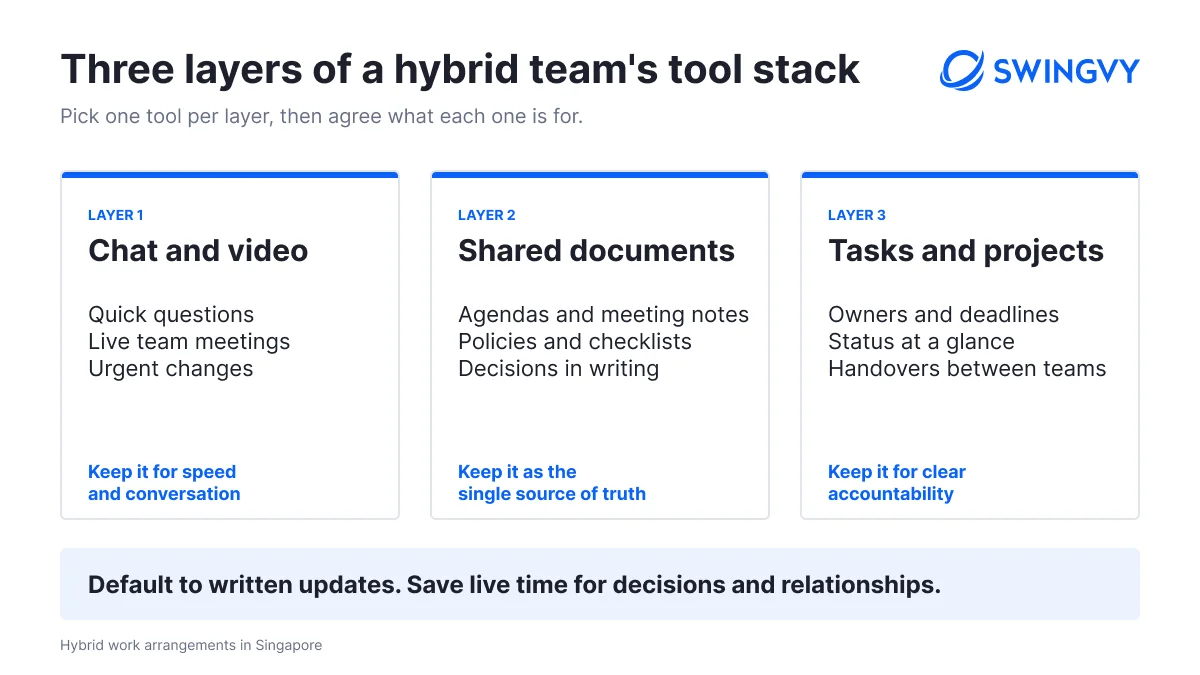
Default to written, asynchronous updates, keep a small number of fixed live touchpoints, and run hybrid meetings so that remote participants have the same voice as people in the room.
Keep the tool stack short: one place for real-time chat and video, one for shared documents, and one for tasks and projects. Then set a rhythm everyone can predict, such as a weekly team sync and regular 1-on-1 meetings between managers and each team member.
For meetings with people in the room and people dialling in, a few rules help:
- Circulate the agenda beforehand and share notes and decisions in writing afterwards.
- Invite remote participants to speak first, so they are not talked over.
- Keep decisions in shared channels, not in side conversations between those who happen to be in the office.
Managing performance when you can't see people at their desks
Manage hybrid teams on agreed outputs and objective measures, not on visible presence. Favouring the people you see in the office is often called proximity bias, and it is the main thing to guard against. The Guidelines expect supervisors to tell employees what work deliverables are expected, how performance will be evaluated while they are on a flexible work arrangement, and what conditions must be met for them to keep using it. They also expect supervisors to review arrangements, including ones already granted, to check that they are working.
The same Guidelines list a supervisor preferring to see an employee in the office, despite consistently satisfactory performance, as an unreasonable ground for rejecting a request. It is a useful test for your own habits: if the only reason for a rule is that managers like to see people at desks, it is unlikely to hold up. The table below turns the four most common worries about hybrid work into practical responses. For measuring output, see our guide on time tracking and productivity.
| Concern | What it looks like | What to do |
|---|---|---|
| Home set-up | Some employees have no quiet or suitable place to work. | Ask about it when you discuss the arrangement, and keep office days or desks available for those who need them. |
| Productivity | Managers worry output drops when they cannot see people working. | Agree deliverables and deadlines up front, then review the results, not the hours at a desk. |
| Isolation | Remote days leave some people disconnected from the team. | Make office days purposeful, and keep regular 1-on-1 conversations. |
| Learning and growth | Junior staff miss informal coaching. | Align their in-office days with the people who mentor them, and plan feedback in advance. |
Attendance, working hours and leave when teams are spread out
Hybrid work changes where people work, so check your policy against the working hours, overtime and leave rules that apply to each employee, and choose one reliable way to record attendance. These guides cover the rules:
- Working hours in Singapore
- Overtime pay rules in Singapore
- Annual leave rules in Singapore
- Sick leave entitlement and eligibility in Singapore
Use the same attendance method for office days and home days, so records are consistent. With Swingvy Time, employees clock in through the free mobile app and managers can see hours and attendance in one place. Swingvy Leave management handles leave requests and approvals online, and HR Hub gives employees self-service access to their own records. Together, they keep records consistent when people are not all in the same place.
Work injury when working from home
Under the Work Injury Compensation Act, employees are eligible for compensation if the injury arises out of and in the course of work, regardless of where it happens, including at home. TAFEP's FAQs add that employers can advise employees on keeping a safe working environment, but because the scheme is no-fault, an employer may still be liable even if the employee did not follow that advice. Read more in our guide to the Work Injury Compensation Act in Singapore.
Onboarding and culture in a hybrid team
Plan hybrid onboarding in four stages: before day one, day one, the first week, and ongoing check-ins. New hires have the least context and the fewest informal chances to pick it up, so give them more structure than the rest of the team.
- Before day one: send equipment, accounts, the first-week schedule and the names of the people they will work with.
- Day one: schedule a live welcome with their manager and buddy, and set out expected hours and how to reach people.
- First week: plan introductions, small first tasks and at least one in-person day if the team is in the office on a regular pattern.
- Ongoing: hold regular check-ins on workload and questions through probation and beyond.
Probation also affects who can make a formal request under the Guidelines (see the section below). For more, see probation periods in Singapore and employee onboarding in Singapore.
Singapore's Tripartite Guidelines on Flexible Work Arrangement Requests: what employers must do
Under the Tripartite Guidelines on Flexible Work Arrangement Requests (TG-FWAR), employers are not required to offer flexible work arrangements, but all employers are expected to have a process to properly consider formal requests and to give a written decision within two months. This section summarises the official position; the full text is in the Guidelines (PDF).
What the Guidelines are and when they apply
The TG-FWAR took effect on 1 December 2024. According to the Guidelines, they replace the 2014 Tripartite Advisory on Flexible Work Arrangements and the 2017 Tripartite Standard on Flexible Work Arrangements, and they set the minimum requirements that all employers should follow. They cover formal requests only. Informal, ad hoc arrangements that already work well can continue, but you still need a process for handling formal requests. See the MOM page on flexible work arrangements and the TAFEP page on the Guidelines.
Who can ask, and how
- Employees who have completed probation can make a formal request. Employers may, but do not have to, accept requests from employees on probation.
- Employers should have a process for submitting requests, for example through a work portal or by email to the supervisor, and should tell employees in advance what information to include.
- If there is no process, an employee can make a formal request in writing, stating the date of the request, the arrangement requested (including its expected frequency and duration), the reason, and the start and end dates if relevant. A request that does not meet this format is not treated as a formal request under the Guidelines.
TAFEP provides a request form template that employers can use for this.
How to respond
Handle each formal request in six steps, ending with a written decision within two months.
- Receive the request and check that it has the information your process asks for.
- Assess it case by case, focusing on factors related to the job, the impact on the business and the effect on the employee's performance.
- Discuss it openly with the employee, and explore ways to accommodate it where reasonably practical.
- Give a written decision within two months of receiving the request.
- If you reject it, state the reason in the written decision, based on reasonable business grounds.
- Discuss alternatives with the employee, which the Guidelines encourage when a request is rejected.
TAFEP provides a response form template for the written decision. For guidance on step two, see TAFEP's guide to managing flexible work arrangement requests for employers. The Guidelines say employers have the prerogative to reject a request, but on reasonable business grounds and not personal bias against flexible work arrangements. The table shows the Guidelines' examples:
| Type | Example grounds (non-exhaustive, paraphrased from the Guidelines) |
|---|---|
| Reasonable ground to reject | The request would significantly increase costs for the employer. |
| Reasonable ground to reject | It would significantly reduce the quantity or quality of individual, team or organisation output, or affect the ability to meet customer needs. |
| Reasonable ground to reject | It is not feasible or practical because of the nature of the job, because other employees' arrangements cannot be changed, or because new hires would be needed. |
| Not a reasonable ground | Management does not believe in flexible work arrangements. |
| Not a reasonable ground | The supervisor prefers to see the employee in the office, even though the employee's performance has been consistently satisfactory. |
| Not a reasonable ground | The organisation's norm is not to offer flexible work arrangements, or it worries that others will ask for the same. |
Common misunderstandings
- "We have to approve every request." No; see MOM's FAQ on approving requests.
- "We can cap how many requests an employee makes." MOM's FAQ on the number of requests says there is no limit, though employees should avoid unnecessary requests.
- "Informal arrangements are covered too." No. Only formal requests are in scope, but you still need a process for them.
- "We can't change an approved arrangement." You can review one early if unforeseen operating circumstances arise, but you should make this clear when you discuss the request. See MOM's FAQ on reviewing an approved arrangement.
- "What happens if we don't follow the Guidelines?" Employees who feel a request was not properly considered may approach TAFEP, which will assess the case and, if needed, guide the employer to comply. See MOM's FAQ on enforcement.
Hybrid work FAQ
What does hybrid work mean?
Hybrid work means splitting working time between the employer's workplace and another place, usually home, on a pattern both sides agree.
Is a flexible work arrangement mandatory in Singapore?
No, employers are not required to offer flexible work arrangements. Since 1 December 2024, however, all employers are expected to have a process to properly consider formal requests from eligible employees, under the Tripartite Guidelines on Flexible Work Arrangement Requests.
How long does an employer have to reply to a flexible work request?
Under the Guidelines, an employer should give a written decision within two months of receiving a formal request. That period includes any clarification and discussion with the employee.
Can an employer reject a hybrid work request?
Yes. Employers can reject a request, but the decision should rest on reasonable business grounds, such as significant cost increases or a significant negative effect on output, and not on personal bias against flexible work. A rejection should come with written reasons.
Can employees on probation make a formal request?
The Guidelines' formal request process is for employees who have completed probation. Employers may choose to accept requests from employees still on probation, but do not have to.
Am I covered by work injury compensation if I'm hurt while working from home?
Yes, if the injury arises out of and in the course of work. The Work Injury Compensation Act looks at the cause, not the place, so a home injury can qualify.
Bringing it together
Hybrid work runs best when the rules are written down and applied evenly. In summary:
- Agree a short policy on who is covered, in-office days, contact hours, location, approval and review.
- Manage on deliverables and objective measures, and keep attendance, hours and leave records consistent across office and home days.
- Have a clear process for formal requests: assess case by case, decide in writing within two months, give reasons for any rejection, and discuss alternatives.
Clear rules and good records are what make hybrid work sustainable for a growing team.
Run hybrid work with less admin
Tracking attendance, leave and employee records across office and home days is easier in one place. Swingvy is a cloud HR platform built for SMEs in Singapore. Swingvy Time, Leave management and HR Hub help your team keep hours, leave and employee records consistent, wherever people work.


